Tier 1 / Lightest
One-time
Quick-Start Playbook
The focused playbook for the stage you're in right now.
- Top 3 plays for your stage
- 7-dimension score breakdown
- Three vendor recommendations
15-page PDF / 12-slide PPT
Yardstick Report pricing
Each tier is personalized to your industry and the readiness stage your audit lands you in. PDF + PPT delivered immediately after checkout, no subscription, no upsells, no follow-up sales calls.
Take the free audit first2-min walkthrough / Pick your depth
At a glance
Tier 1 / Lightest
One-time
Quick-Start Playbook
The focused playbook for the stage you're in right now.
15-page PDF / 12-slide PPT
Tier 2 / Standard
One-time
Strategic Roadmap
Everything in Quick-Start, plus all four stages mapped to your stack and the full vendor scorecard.
30-page PDF / 22-slide PPT
Most chosen
Tier 3 / Deepest
One-time
Full AI Deployment
Everything in Strategic Roadmap, plus the CFO-defensible ROI model and an exec-ready summary slide.
45-page PDF / 32-slide PPT
Detail, sample excerpts, and what's included for each tier. Below.
How it works
01
About 25 questions, calibrated to your industry. You'll see your readiness score, peer benchmarks, an annual savings estimate, and three vendor recommendations on the next page, free, no email required.
02
If you already know your stage and just need the focused playbook, Quick-Start is enough. If you're planning the full Foundation to Optimization journey, Strategic Roadmap. If you need the CFO-defensible business case, Full AI Deployment. Each tier is described in detail below, including what a real excerpt looks like. Pricing is shown at checkout.
03
Stripe checkout takes 30 seconds. Your PDF + PPT are generated server-side from your audit answers and downloaded as a signed link. The link is good for 24 hours. Refresh the page to regenerate.
Tier 1 / Quick-Start Playbook
For buyers who already know their readiness stage and want the focused playbook, not the full journey.
If you already know your stage and don't need the full roadmap: the three plays that move your score most in the next 90 days, the breakdown that explains why those three, and the vendors that actually fit your CRM and scale. The smallest, most opinionated tier, no multi-stage roadmap, no ROI model. Just the play-by-play for the quarter ahead.
The focused playbook for the stage you're in right now.
The implementation plan / 3 steps over your current quarter
Every Yardstick plan starts with data integration / engineering. Quick-Start keeps the plan tight: get the CRM data clean first, then run the three plays for your stage
Data integration baseline
Run the top 3 plays for your stage
Re-measure and decide
Quick-Start scopes one quarter. Buyers who need the full Foundation to Optimization plan move to Strategic Roadmap
The PDF / 15 pages
Below: real pages rendered from a sample report. This is what the generator outputs
Cover page
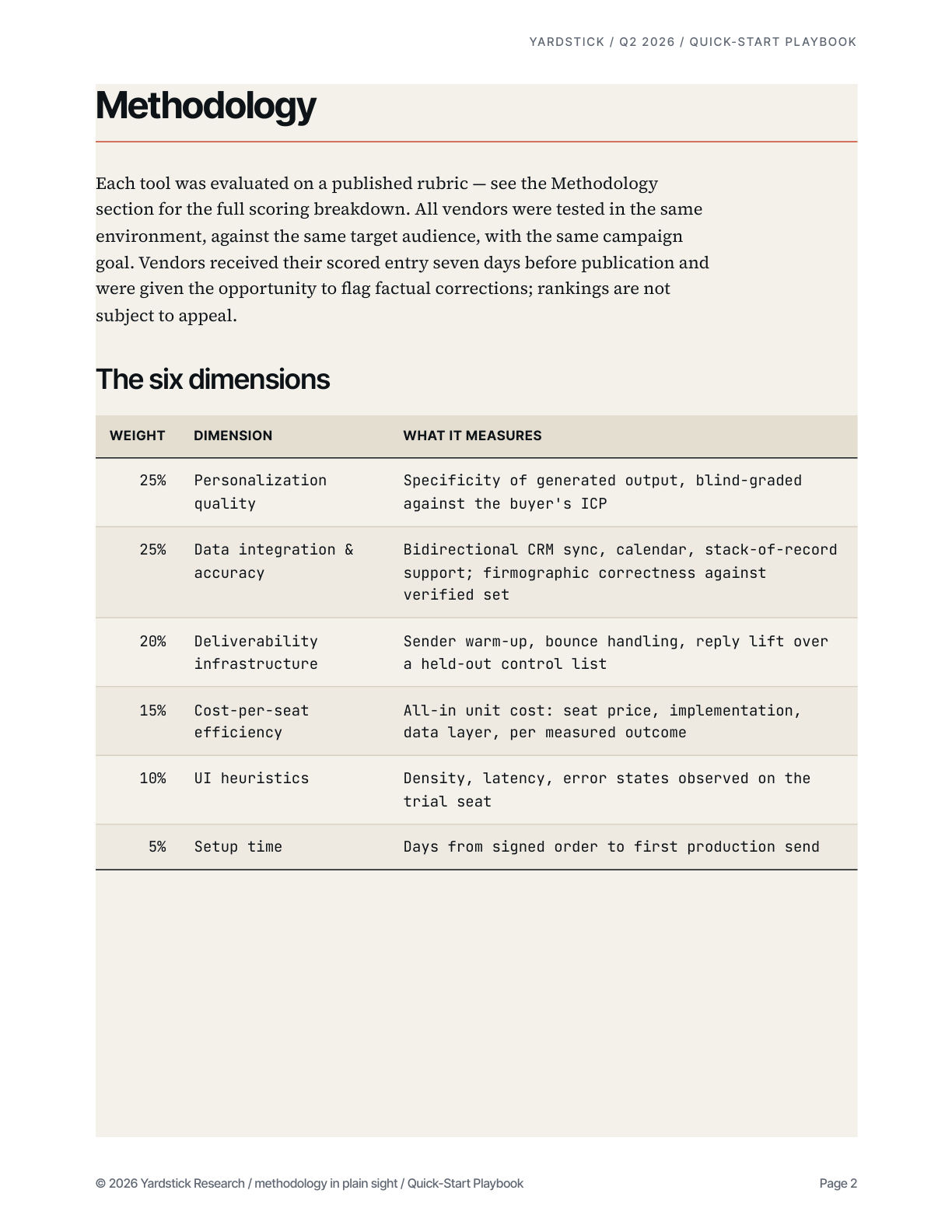
Methodology / 6-dimension rubric
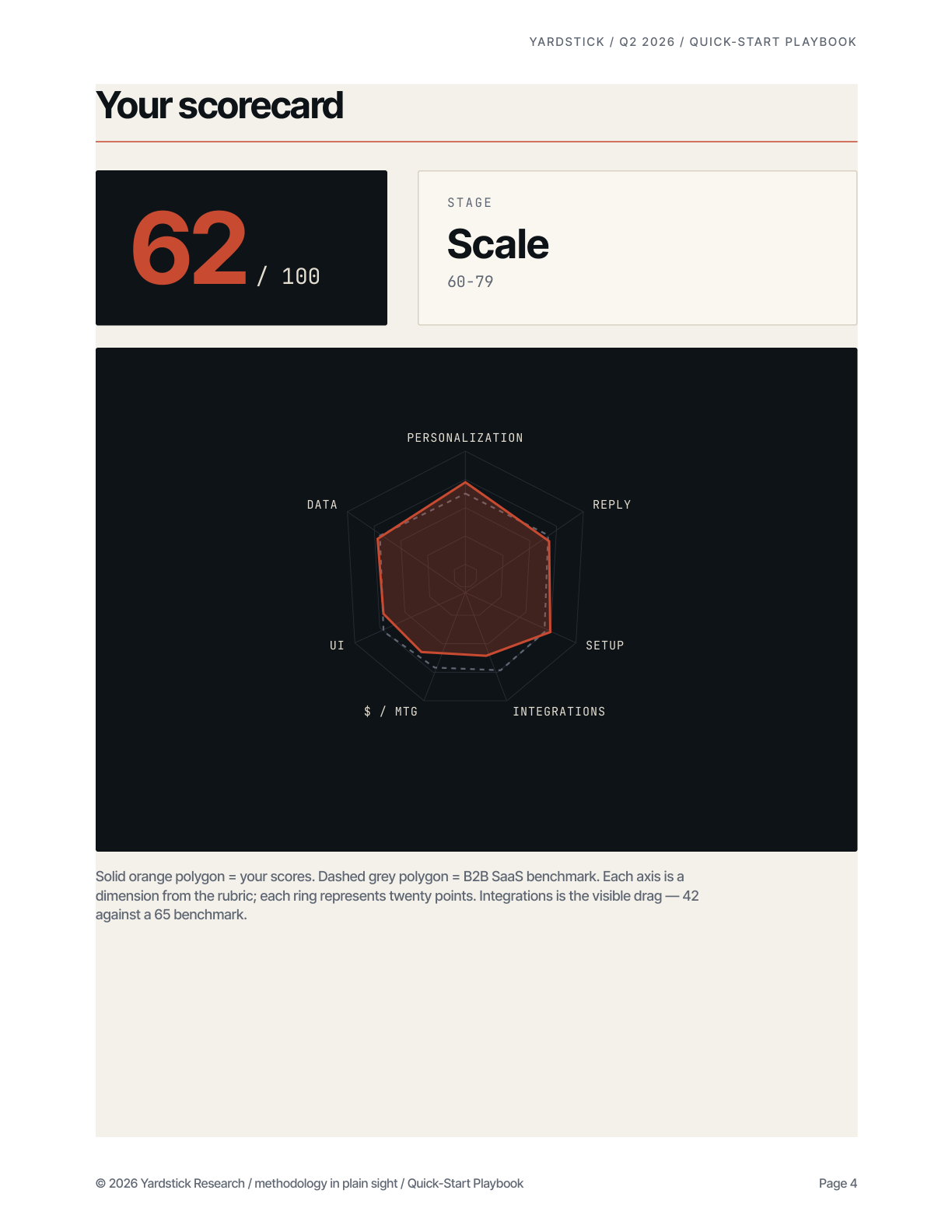
Your scorecard
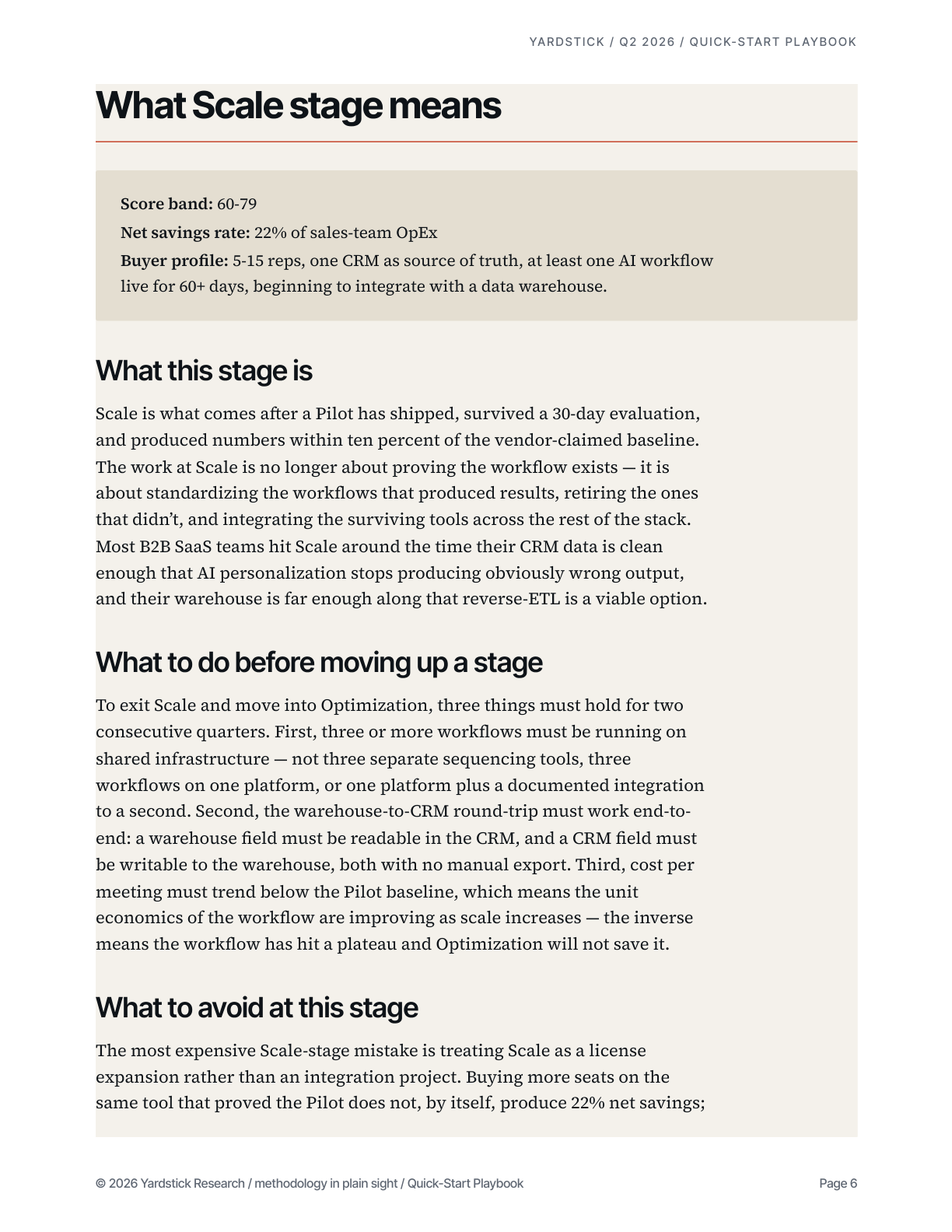
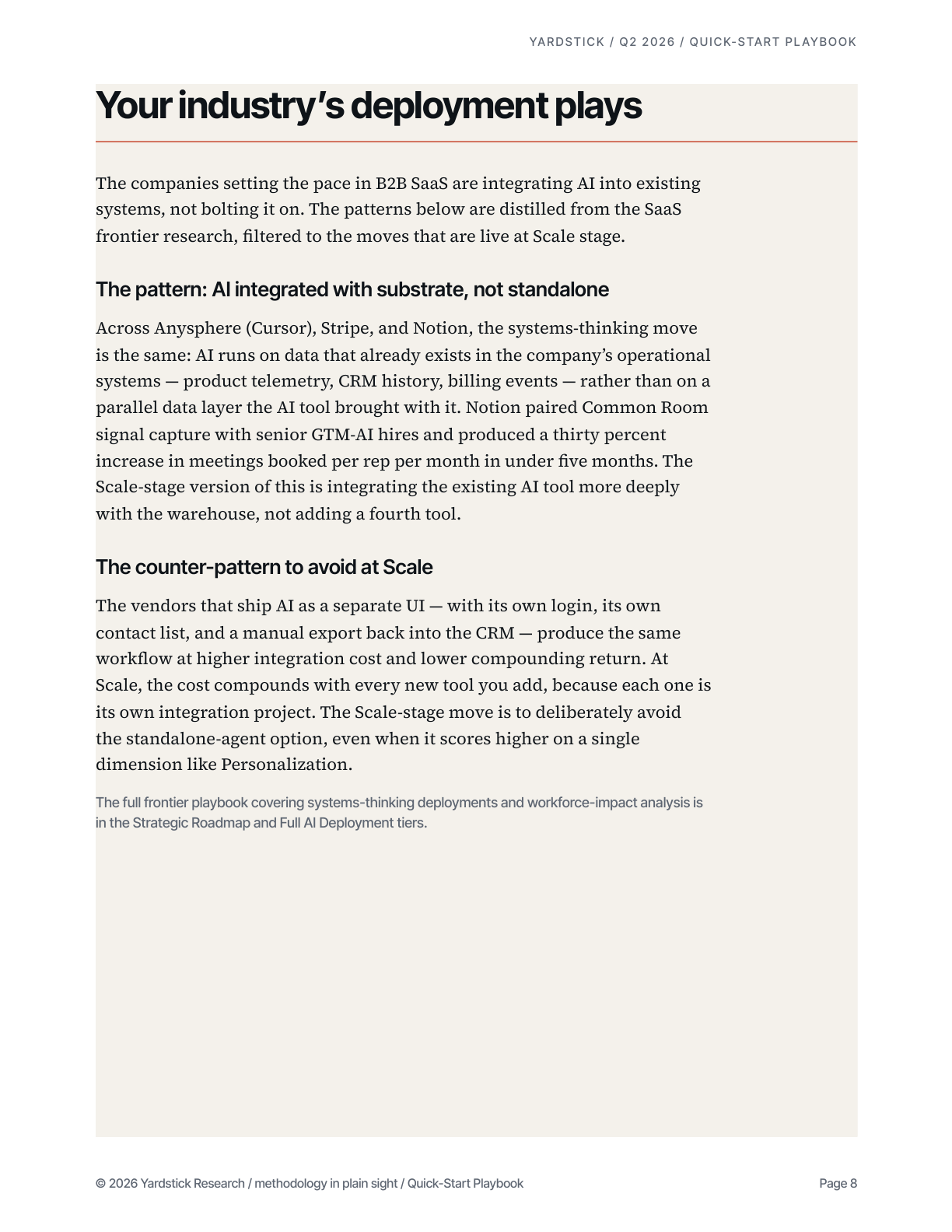
Stage-stage plays
Vendor recommendations
The PowerPoint / 12 slides
The deck you actually share with your manager. Same content as the PDF, formatted for the share-with-manager moment
The top 3 plays for your stage / the core deliverable
What the free audit does not give you. The actual moves to make next quarter, with owner, data needed, expected outcome, and time to value on each one
Cold-email A/B pilot using your existing Outreach + Lavender
Hold out a control list of 200 accounts. Measure reply lift over a four-week window. If Lavender personalization is enforced on every send, the lift band lands inside the range above.
Enrichment audit and dedupe pass against Apollo free tier
Run your current contact export through Apollo's free tier. The documented gap-rate per ICP segment is the baseline you measure future enrichment vendors against.
ICP signal layer: pick 2 of 3 triggers (tech-stack / hiring / funding)
Backtest two of the three trigger types against your existing customer list. The output is a documented trigger to response playbook that sales can actually run.
Free audit gives you a score. The Quick-Start Playbook gives you the move
The vendors we did not pick / unique to Quick-Start and up
The free audit silently filters. The Quick-Start Playbook shows you which vendors were excluded and why, so you don't waste a demo on a tool we already screened out
Every exclusion is documented in the report so you do not waste a demo
The methodology appendix / the rubric reprinted
Every claim labelled MEASURED / ESTIMATED / CITED. The scoring rubric is reprinted at the back so you can defend the picks to your stakeholders
Observed first-hand on the free tier or trial seat, or graded by us against a sample prospect.
Derived by us from the vendor's own pricing page and feature limits.
Sourced from a vendor-published benchmark or a third-party review, with the source linked.
Weights sum to 100%. Affiliate links disclosed on every page they appear
The videos / 2 industry walkthroughs
Two short videos calibrated to your industry. Methodology walks through how the scorecard is built. Frontier covers the systems-thinking deployments running today
How Yardstick scores AI Sales for B2B SaaS
AI Sales frontier companies / B2B SaaS
The audit takes 4 minutes and is what tailors the Report to your industry, stack, and readiness stage. Without it, you'll receive an industry-default version.
Take the audit to see if Quick-Start is your tier, and what your specific plays would be. Start the audit to
Tier 2 / Strategic Roadmap
For buyers planning the full Foundation to Optimization journey. The standard tier. What most buyers actually need.
The Quick-Start Playbook covers the next 90 days. Strategic Roadmap covers the next two years: all four readiness stages (Foundation, Pilot, Scale, Optimization) mapped to your industry and stack, plus the industry-specific workforce-impact analysis CFOs actually read. If you don't already know your stage cold or you're planning a multi-quarter rollout, this is the tier most buyers buy.
Everything in Quick-Start, plus the full multi-quarter plan.
The implementation plan / 5 stages over 24 months
Strategic Roadmap maps the full Foundation to Optimization journey. Data integration / engineering is the Foundation step that everything else depends on. Each stage has an exit criterion - the gate that tells you you are ready to move on
Data integration and engineering baseline
Gate: data quality > 85%, email reputation healthy, ICP documented
Bounded pilot with a control
Gate: measurable reply lift vs the control. Inside the documented industry band
Standardize the stack
Gate: stack live across the team, reporting unified, no parallel systems
Workforce shifts and governance
Gate: org-chart shifts documented and on track
Attribution and continuous optimization
Gate: every workflow has a control and a measurable lift number
Buyers planning a CFO conversation also need the ROI math. That lives in Full AI Deployment
The PDF / 30 pages
Below: real pages rendered from a sample report. This is what the generator outputs
Cover page
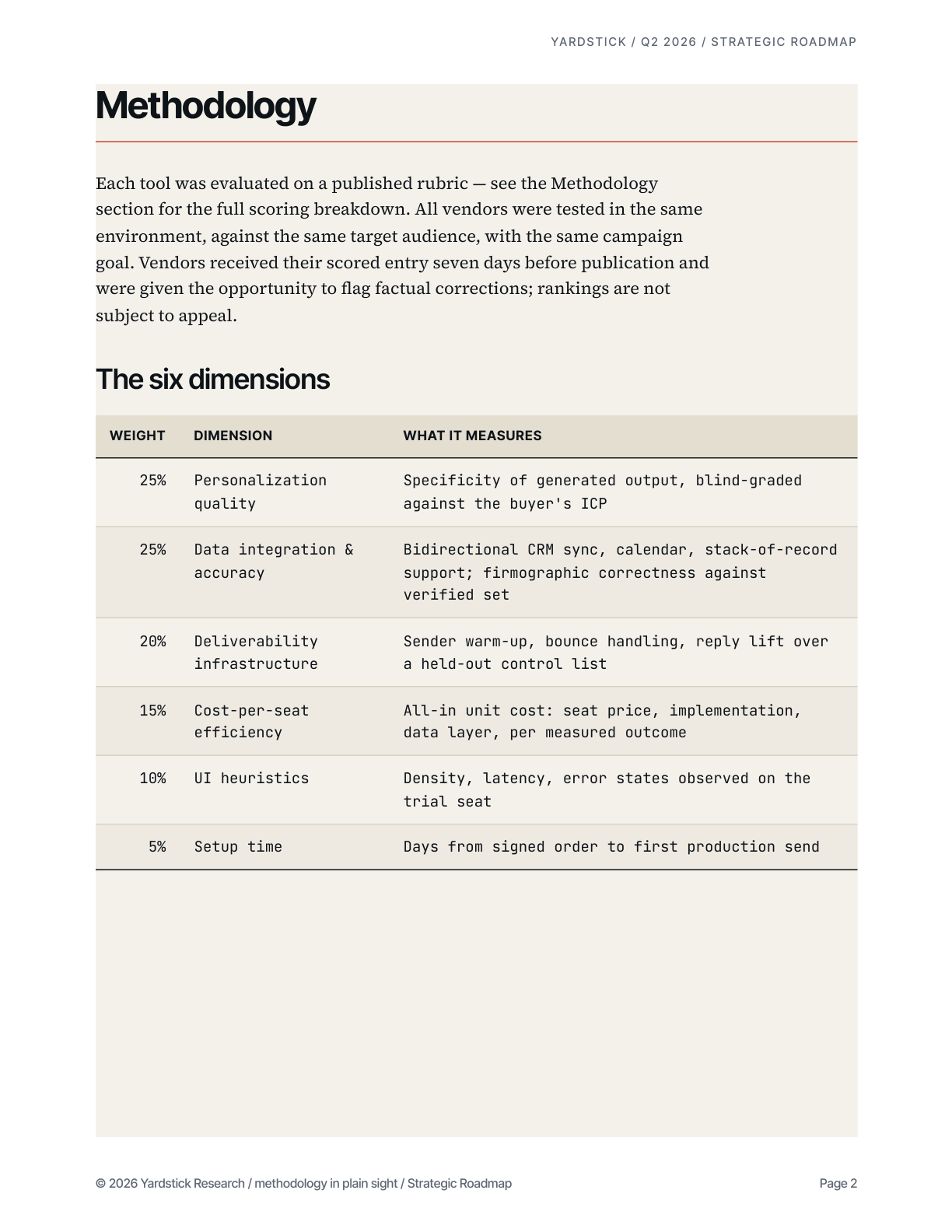
Methodology / 6-dimension rubric
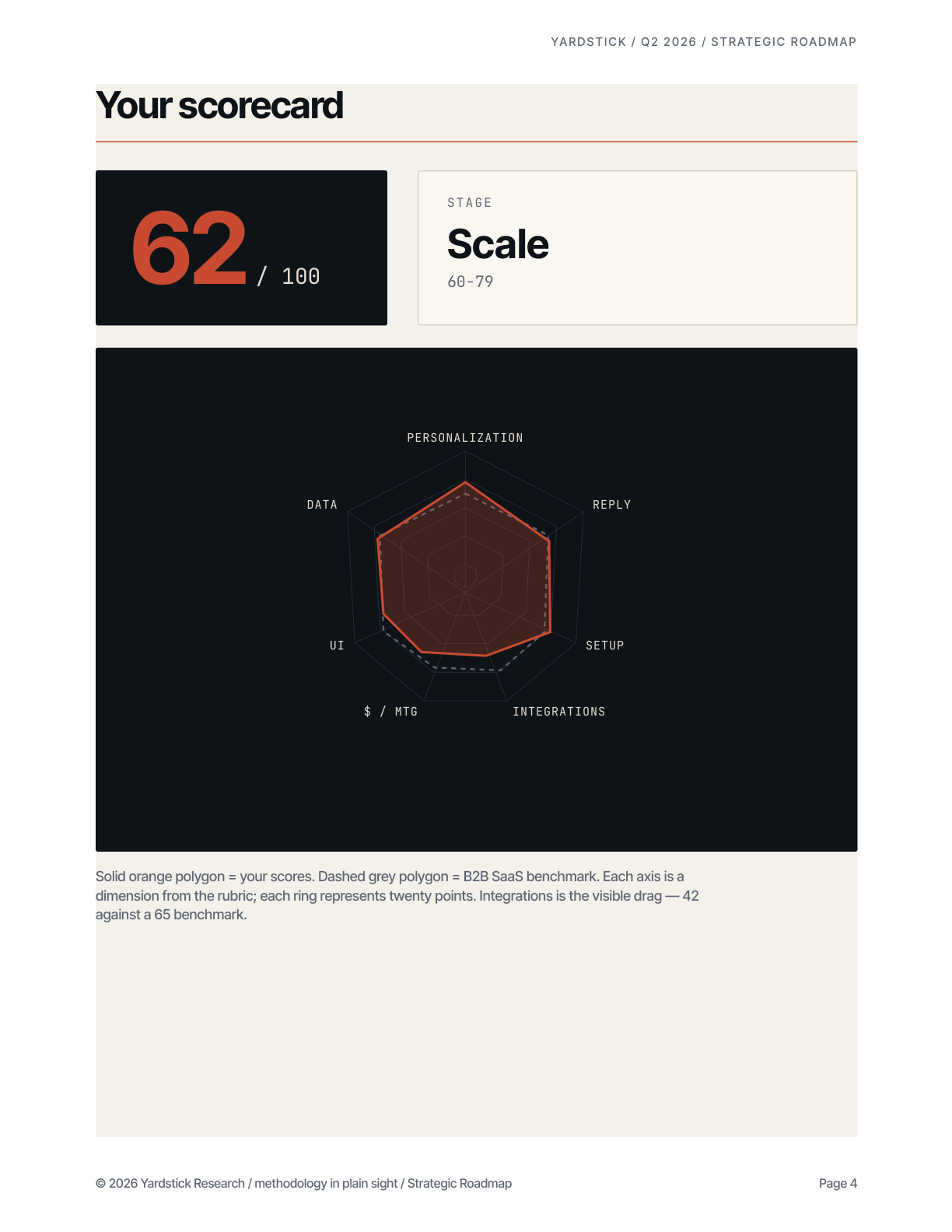
Your scorecard
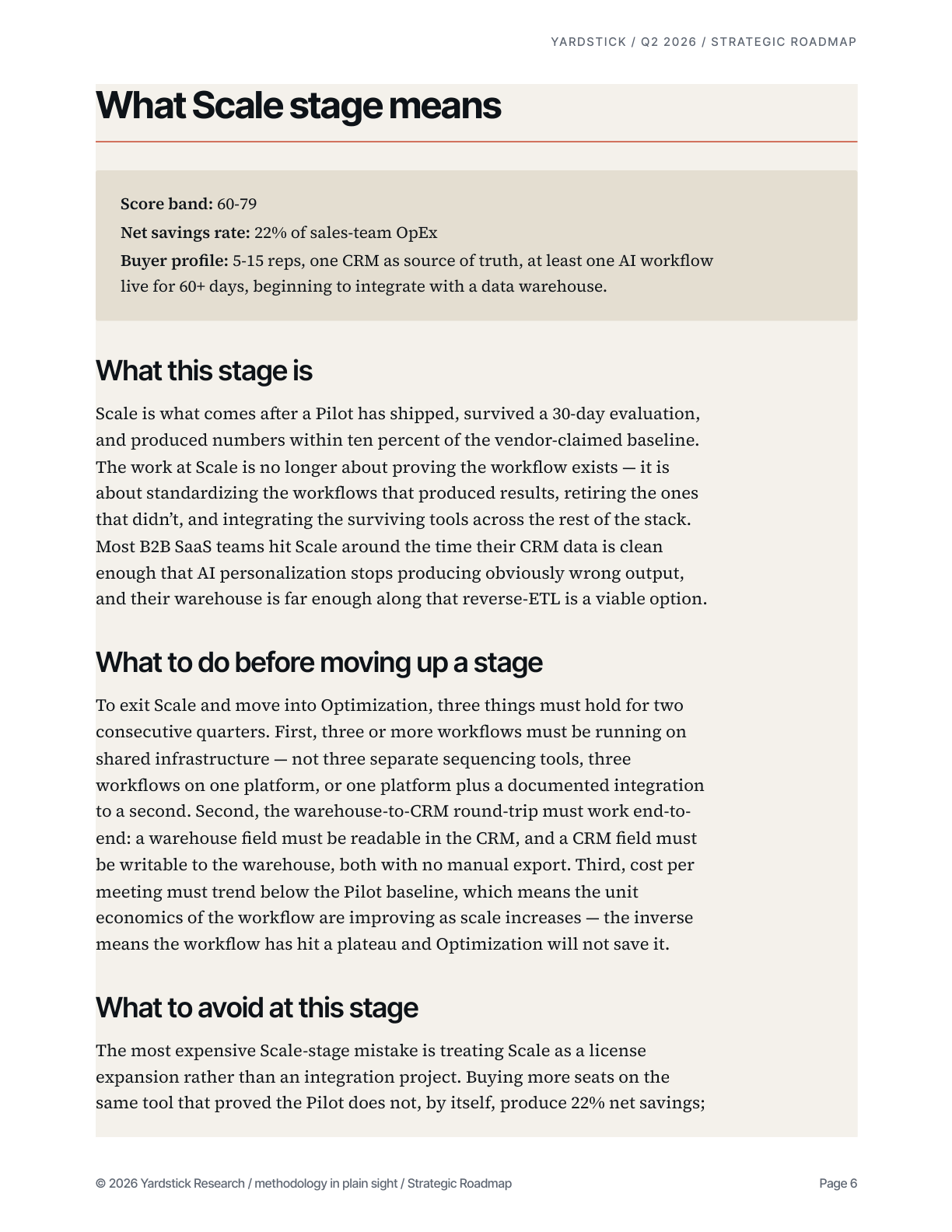
Four-stage roadmap
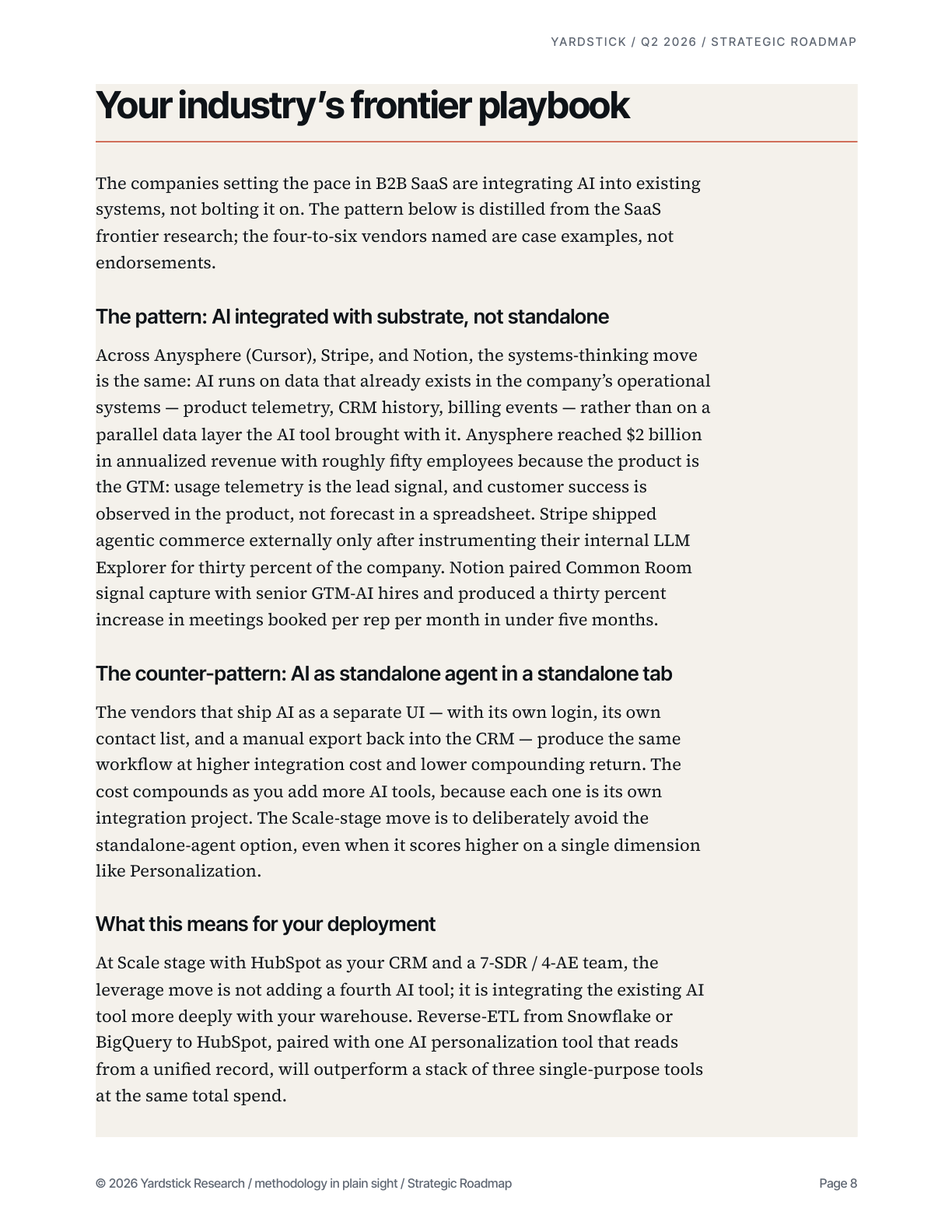
Vendor scorecard / full cohort
The PowerPoint / 22 slides
The deck you walk the team through. Stage-by-stage, with the savings math and the vendor scorecards laid out for a room, not a binder
The videos / 2 industry walkthroughs
Two short videos calibrated to your industry. Same source files as Quick-Start, but Strategic Roadmap buyers see the full four-stage Frontier deep dive
How Yardstick scores AI Sales for FinTech
AI Sales frontier companies / FinTech deep dive
The four-stage roadmap / unique to Strategic Roadmap and up
Quick-Start covers the next 90 days. Strategic Roadmap maps every stage your business will move through over the next two years. Each stage has its own play-by-play, exit criteria, and anti-patterns to avoid
Foundation
0-6 mo
Pilot
6-9 mo
Scale
9-18 mo
Optimization
18+ mo
Strategic Roadmap maps all four stages to your specific stack. Quick-Start covers only your current stage
The workforce-impact analysis / unique to Strategic Roadmap and up
A short analysis of how AI sales tools shift roles in your industry. Which roles compress, which expand, on what timeline. So your SDR headcount math does not surprise you a quarter in
| Role | Direction | Timeline | What changes |
|---|---|---|---|
| SDR | -20 to -30% | 9-18 mo / Pilot to Scale | AI sequencing takes over the first-touch workflow |
| Compliance-ops | +1 per 15 reps | Before Scale | Every AI-generated message needs an auditable approval trail |
| AE | Time to quota | 18+ mo / Optimization | Qualification data is richer at hand-off, time to quota improves |
| RevOps | +1 to +2 heads | 9-12 mo / Scale | Workflow stack ownership consolidates here |
Industry-specific. Healthcare, retail, manufacturing each get a different displacement table
The stack-fit matrix / every vendor on one page
Every vendor's integration depth, scale-fit headroom, and industry-lock status laid out side by side. The hard exclusions are visible, not hidden in an appendix
| Vendor | CRM integration | Scale-fit | FinTech-fit |
|---|---|---|---|
| Outreach | Native | Yes | GDPR-clean |
| Lavender | Via Outreach | Yes | Yes |
| Cognism | Native | Yes | EU + UK data |
| Apollo | Native | Yes | Partial |
| Reply.io | Via Zapier | Yes | No EU data |
Continues for 9 more vendors. Vendors that fail any column show up with the reason printed
The audit takes 4 minutes and is what tailors the Report to your industry, stack, and readiness stage. Without it, you'll receive an industry-default version.
Take the audit to see if Strategic Roadmap is your tier, and your specific stage path. Start the audit to
Tier 3 / Full AI Deployment / Most chosen
For revenue leaders building a CFO-defensible business case. The tier you take into the budget conversation.
For the harder problem: convincing your CFO to fund it. Everything in Strategic Roadmap, plus a three-scenario ROI model (Conservative / Base / Aggressive), a 3×3 sensitivity grid, and a monthly NPV at 10% discount. Every number traces back to a documented input, no black-box "AI will save you $X" claims. Mostly bought at Scale or Optimization stage; Foundation and Pilot buyers usually don't need it yet.
Everything in Strategic Roadmap, plus the CFO-defensible business case.
The implementation plan / 7 stages with CFO checkpoints
Full AI Deployment ties the operational rollout to the financial model. Data integration / engineering still goes first, but now every stage has a CFO or board checkpoint, with NPV reforecasts on a quarterly cadence
Data integration and engineering baseline + cost-of-ownership audit
Gate: data quality + cost baseline established, both documented
Executive alignment and budget approval
Gate: budget approved, KPIs signed, sensitivity bands accepted
Bounded pilot with NPV instrumentation
Gate: pilot lift inside the Base scenario band, NPV trajectory on track
Scale rollout with quarterly NPV reforecast
Gate: 4 consecutive quarters within the Base case
Workforce shifts, CFO-tracked
Gate: org-chart matches the documented plan within 10%
Continuous attribution with monthly CFO reporting
Gate: cumulative NPV beats Base case by 10%, or replan
Annual program review with the board
Gate: program funded into the next year at Base+ or replanned
Every gate is documented and signed before the next stage begins; the implementation plan in your Report carries the same gate checklist into your team's tracker of choice
The retraining plan and timeline / 4 phases coordinated with the rollout
Full AI Deployment is the only tier that ships a workforce-impact retraining plan. The headcount math in the implementation plan tells you which roles compress. This document tells you what you owe the people in those roles, when, and at what cost. Reserved for Full AI Deployment because this is the only tier where the workforce shift is large enough to need a formal program.
Skills inventory and upskill kickoff (paired to Foundation)
Commitment: KPI baselines are HR-owned and walled off from comp review. They exist to match people to the right transition track, not to build a layoff justification file. Nobody hears about their role change for the first time during a layoff either: notice precedes action by at least one full phase.
Transition tracks opened (paired to Pilot)
Commitment: "completed the track" means cleared the rubric, not just sat through the class. Any SDR who wants to stay gets a funded path, a mentor, pay protection, and a published bar. The track and its rubric have to exist before the role compression starts.
Workforce shift execution with structured offramp (paired to Scale)
Commitment: the severance pool is treated as a real line item in the financial model from day one, not a surprise charge in quarter four. The CFO has already approved it as part of the budget gate.
New role formalization and annual program review (paired to Optimization)
Commitment: the retraining program is measured the same way the financial model is measured. If the placement rate slips, the next year's plan changes before the next round of compression runs.
Retraining plan is co-owned by HR and the CFO. Each phase has a documented commitment and milestone view so HR and operators are working from the same map
The PDF / 45 pages
Pages shown: rendered from the Strategic Roadmap sample (the closest available real preview). Full AI Deployment adds the three-scenario ROI model, 3x3 sensitivity grid, 36-month NPV, and exec-ready summary slide in the same visual style.
Below: real pages rendered from a sample report. This is what the generator outputs
Cover page
Your scorecard
Four-stage roadmap
Vendor scorecard / full cohort
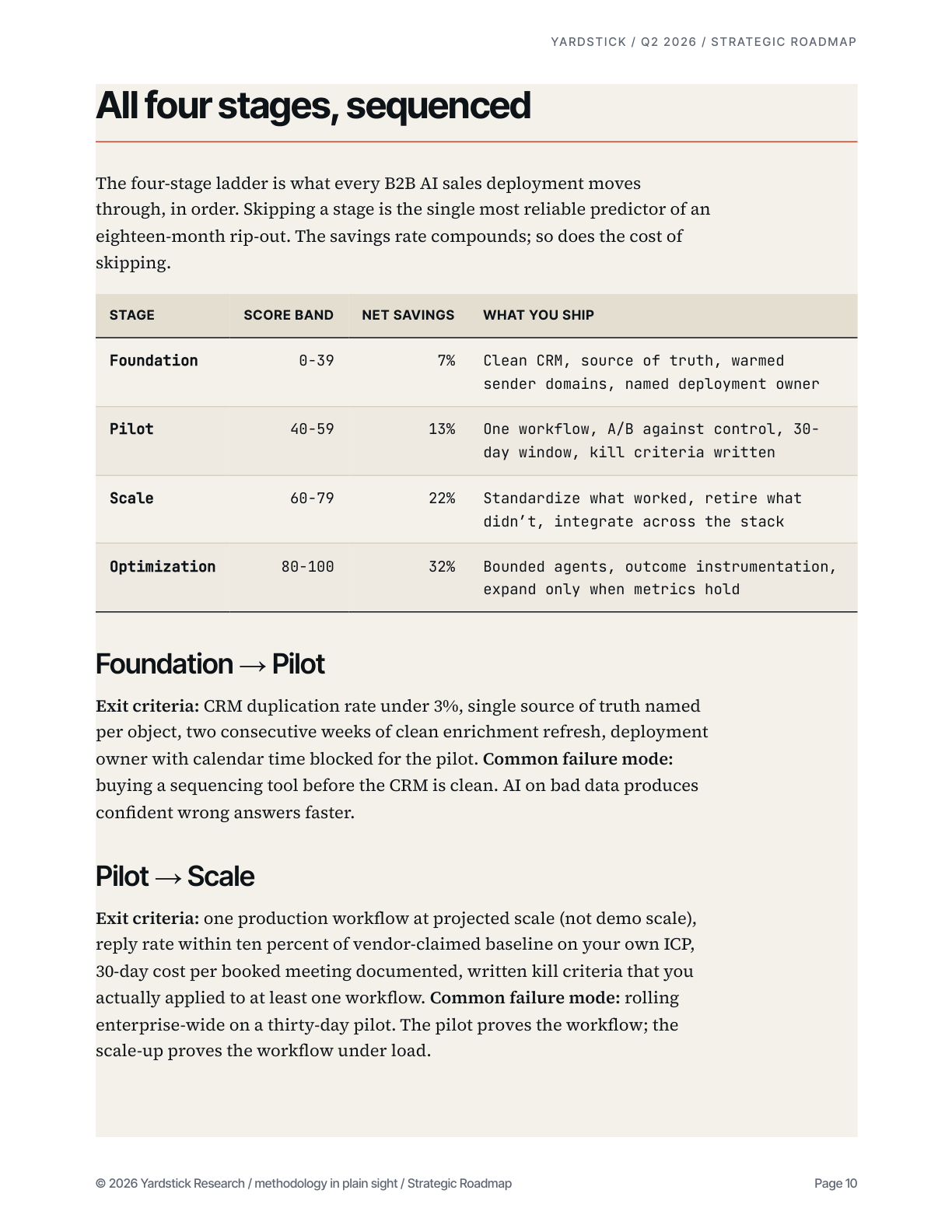
Annual savings estimate
The PowerPoint / 32 slides
The deck you walk the CFO through. Everything in Strategic Roadmap plus the ROI math, sensitivity grid, NPV chart, and the one-slide exec summary built for the board deck
The videos / 2 industry walkthroughs
Two short videos calibrated to your industry. The Frontier video at this tier adds the workforce-impact analysis and the org-chart shifts CFOs ask about
How Yardstick scores AI Sales for Manufacturing
Frontier deep dive + workforce-impact analysis
The vendor cost-of-ownership comparison / unique to Full AI Deployment
Not just license cost. Setup time times your loaded labor, plus integration depth times switching risk, plus scale-fit headroom. The tools that look cheap per seat often are not
| Vendor | License (3yr) | Setup x labor | Integration risk | Total burden |
|---|---|---|---|---|
| Outreach | $378k | $24k | $8k | $410k |
| Salesloft | $342k | $58k | $74k | $474k |
| Reply.io | $216k | $96k | $112k | $424k |
| Apollo Enterprise | $294k | $42k | $28k | $364k |
Best total burden highlighted. Setup labor and integration risk often outweigh per-seat price differences
The audit takes 4 minutes and is what tailors the Report to your industry, stack, and readiness stage. Without it, you'll receive an industry-default version.
Take the audit to see if Full AI Deployment is your tier, and what your specific ROI numbers would be. Start the audit to
Pricing FAQ
The audit is free. Your tier picks itself based on what you score.
Take the free auditYou're buying the for .